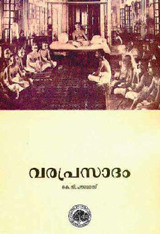
Collection of articles.
Kamadhenu Centre for Sanskrit Studies
Vallathol Vidyapeetham
Sukapuram
Edapal 679576
Kerala
Tribute to a Sanskrit scholar
VARAPRASADAM IS the most beautiful title one can give to a book dedicated in memory of a beloved guru. K.G. Poulose's `Varaprasadam' is the fittest tribute to his late guru, T.K. Ramachandra Iyer. None must have had the pleasure of blessing (Varaprasadam) from Prof. Iyer as much as Mr. Poulose. The emotional strings found in the book, therefore, are nothing but natural. The dedication of this scholarly work took place at the annual Sastra Sadas held at the Government Sanskrit College, Thripunithura, on Saturday. The guru honoured was a former principal of the college. True, Mr. Poulose pays profuse obeisance to the late Ramachandra Iyer. But he strives on to make the 168-page book a treatise on the contributions of Kerala to the language and literature of Sanskrit. Most of the observations he makes in the book are uniquely different. Mr. Poulose does not make any attempt in the Thilodakam (obituary) to blur his closeness to Prof. Iyer, who had chosen an ascetic life before he died in March this year. The chapters that follow are an attempt to answer the question why Sanskrit in Kerala differed from the other parts of the country, particularly the North. Mr. Poulose has found three reasons: Namboodiri culture trickled down to the lower level in Kerala much faster than other places; the popularisation of Ayurveda at `asari', `velan' and `vaidyar' levels through the influence of Buddhist teachings; and the replacement of Vaisya community by Jews, Muslims and Christians in Kerala. Mr. Poulose also goes on to describe the Thripunithura tradition of Sanskrit scholarship, with specific reference to a few doyens as well as the Sanskrit College set up by Rajarshi Rama Varma in 1914. In the second part, the author gives a fairly detailed sketch of six Sanskrit luminaries whose formal education proved no yardstick to measure their scholarship. They are Rajarshi Varma, Pareekshit Thampuran, Sahridayathilakan Rama Pisharady, Anantha Narayana Sastrikal, Sankara Narayana Sastrikal and G. Viswanatha Varma. Together they stood for the Sanskrit renaissance. Rajarshi and Pareekshit are described ``princes among scholars''. The third section comprises the articles written at different times. Chapters like Ramayaneeyam, Narayaneeyam and Bhagavad Gita present a different perspective. The cover picture of a Sastra Sadas presided over by Pareekshit Maharaja is a rare one.
By Abdul Latheef Naha
© Copyright 2000 - 2009 The Hindu
Courtesy: The Hindu
Web URL: http://www.hindu.com/lf/2003/12/28/stories/2003122800190200.htm